A cracked or dead microSD is a fork in the road, not a single procedure. If the controller still runs & only a contact trace is severed, a targeted microsoldering jumper can bring the card back with no decapsulation at all. If the controller is dead, the only way to the data is full test-pad NAND extraction. This page is about which fork your card is on.
We recover monolithic microSD cards in-house at our Austin, TX lab. Free evaluation, firm quote before any paid work, & no charge if the data doesn't come back. Mail-in from anywhere in the U.S.
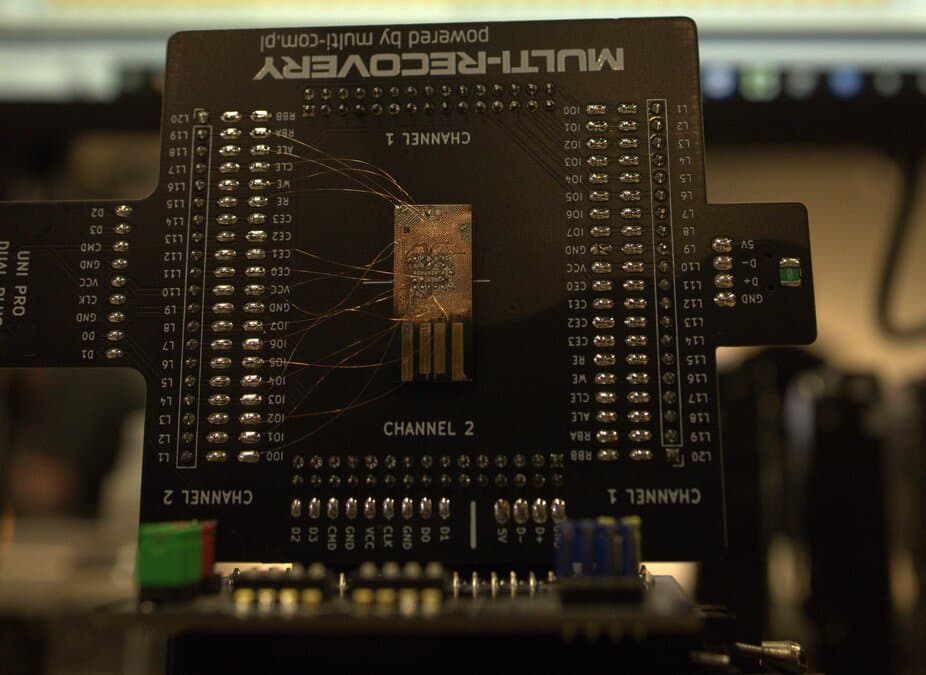
Spider board needles contacting exposed NAND test pads on a monolithic microSD. This is the extraction path, used when a contact-trace repair can't bring the card back.

A monolithic microSD seals separate NAND & controller dies, wire-bonded inside one epoxy Chip-on-Board package. Physical-damage recovery takes one of two paths: when the controller survives & only a contact trace is broken, a microsoldered jumper restores enumeration; when the controller is dead, the die is abraded open & its test pads read with PC-3000 Flash, then reconstructed in software. Neither path recovers a fractured NAND die.
Neither path recovers data that never reached a die either, which is what happens when a counterfeit card reports capacity its flash does not have. Reading the raw silicon returns erased pages, because the controller discarded those writes instead of programming them.
The determining question is where the fault sits: in the path from the external contacts to the controller, or in the controller itself. A break in the contact path is repairable without ever opening the package. A dead controller is not, & forces the extraction path.
Most cracked, snapped, & scratched-contact microSD cards fail because the thin copper traces between the gold pads & the internal die get severed, not because the silicon died. The controller & NAND are intact; they just can't talk to a card reader anymore because the wire between them is cut.
On those cards the least invasive fix is a jumper: under a stereomicroscope, we bridge the severed trace with hair-thin wire on a Hakko FM-2032, the controller powers up normally, & the card enumerates & copies off like nothing happened. No epoxy comes off.
That work lives in the file-system & PCB-repair tiers ($300–$600 to $600–$900).
A trace repair only works while the controller is alive. If the controller latched up, shorted its power rail, or panicked its firmware during a write, no jumper brings it back, because the part doing the reading is the part that's broken.
Then the card goes to full test-pad extraction: abrade the epoxy off the die, expose the factory technological test pads, bond the spider board's needles to the raw NAND bus, & read the flash directly with PC-3000 Flash, without the dead controller in the loop. That is the chip-off tier at $1,200–$1,500, & it carries a 50% deposit because decapsulation is destructive to the card.
One fault kills both paths: a fractured NAND die. If the crack ran through the memory silicon itself, the cells in the fracture zone are physically broken, & the data written there is gone.
A jumper has nothing to reconnect & a raw read returns dead pages. We can still recover whatever the intact portion of the die holds, but we tell you up front when a fracture caps what's possible, & we don't charge for data we can't return.
| What Failed | Recovery Path | Recovers Only If |
|---|---|---|
| Severed contact trace, controller alive | Microsoldered jumper, no decapsulation | Controller & NAND die both intact |
| Dead controller (latch-up, short, firmware panic) | Full test-pad NAND extraction | NAND die unbroken, charge loss within ECC margin |
| Fractured NAND die | Partial read of the intact die area only | Wanted data sits outside the fracture zone |
A monolith routes the internal NAND bus to microscopic factory test pads on the bottom of the die substrate. The microSD is the smallest of these packages in common use, roughly the size of a fingernail, so the same test pads have to be worked in the tightest physical footprint we handle. A full-size SD card or a monolithic USB drive gives us more room around the same signal set.
Less working room means less margin for error at every step. Decapsulation has to grind the epoxy down to copper without slipping into an adjacent trace.
Needle placement has to seat each probe on its pad without shorting to the neighbor a fraction of a millimeter away. On a microSD the whole NAND interface, an 8-bit data bus plus the command, address, enable, & ready lines, is compressed into that fingernail footprint.
The signal set itself is standard, & we don't re-derive it card by card. The generic NAND pinout, D0 through D7, CE, CLE, ALE, WE, RE, WP, & R/B, is documented in our monolith flash recovery database, alongside the per-family layouts we match against. What the microSD form factor takes away is physical margin, not signal knowledge.
That margin is why the extraction path is one-shot on this form factor. Grind one trace off the die during decapsulation & that signal line is gone; you can't solder back metal you've turned to dust. It's also why we don't open a card at all when a contact-trace jumper can bring the controller back instead.
Reading the NAND is acquisition, not recovery. The raw dump that comes off the test pads is a fragmented, interleaved, XOR-scrambled binary matrix, stripped of the assembled logical-to-physical map the dead controller used at runtime.
That live map is gone, but its underlying mapping metadata is written into the NAND spare area, which is what makes reassembly possible. Rebuilding a file system means reversing the specific controller's handling of the data, & that handling is closed, proprietary intellectual property, different for Phison, Silicon Motion, SanDisk, & Samsung parts.
The dump goes through bad-column removal first, realigning the data around the defective physical columns the die mapped out at the factory. Then ECC correction & XOR descrambling run in the order the specific controller requires.
Most controllers compute ECC parity over the scrambled data, so ECC correction precedes descrambling; ACE Lab documents ITE, SSS, & AU controllers that need XOR descrambling applied first. Get the order wrong for the part & the output stays noise.
The last stage is page assembly: parsing the spare-area metadata on each physical page, the logical sector numbers, block sequence numbers, & wear-level counters, to re-link the scattered pages into contiguous logical sectors. Only then does a recognizable FAT32 or exFAT volume appear that mounts & hands back files. PC-3000 Flash carries the maintained databases of XOR patterns, ECC schemes, & page formats that make this deterministic; a cheap NAND programmer can pull the same dump & produce nothing usable from it.
This stage has its own failure wall. Flash cells leak trapped charge over time, worse on worn or heat-stressed TLC, & a card left unpowered for years can drift below the read reference voltage.
We re-read at shifted reference voltages to pull marginal cells back within the correctable margin, but once retention loss pushes the raw bit-error rate past what ECC can fix, those pages are unrecoverable. Reconstruction returns the data the die still physically holds, not what has leaked away.
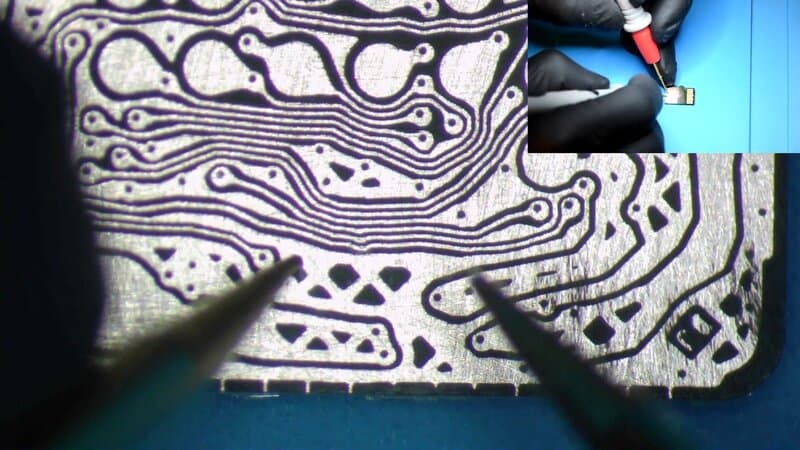
Exposed factory test pads on a decapsulated monolithic microSD die. Each pad carries one NAND signal line the spider board must contact to read the raw flash.
This is the decision path on the bench. A cracked 128 GB SanDisk microSD comes in with damaged contacts; the walkthrough covers repairing the severed trace, then reading the NAND directly when that's what the card needs. It's the same fork every physically damaged monolith presents: fix the path to the controller, or read the NAND without it.
The full recovery runs about 75 minutes end to end, filmed in one take at the lab. It shows the microsoldering, the pad work, & the raw read that a written page can only summarize.
Price follows the path the card needs. A contact-trace jumper that leaves the controller in charge sits in the lower tiers; full test-pad extraction with raw-NAND reconstruction is the chip-off tier. Flash & microSD recovery runs $200–$1,500 across 4 tiers, with no charge if the data is unrecoverable.
Low complexity
Your flash drive or SD card works, you just need the data moved off it
Functional media; data transfer to new storage
Rush available: +$100
$200
3-5 business days
Low complexity
Most Common
Your flash drive or SD card isn't showing up, but it's not physically damaged
File system corruption. Visible to recovery software (R-Studio, UFS) but not to OS
Starting price; final depends on complexity
$300–$600
2-4 weeks
Medium complexity
Your flash drive or SD card has shorted components or won't power on
PCB issues: simple shorts, failed components on the drive's circuit board
May require a donor drive (additional cost)
$600–$900
3-6 weeks
High complexity
Your flash drive or SD card needs physical NAND chip extraction to recover the data
NAND chip extraction via soldering, pin-out identification, and raw data reconstruction
50% deposit required
50% deposit required
$1,200–$1,500
4-8 weeks
Our "no data, no fee" policy applies to hardware recovery. We do not bill for unsuccessful physical repairs. If we replace a hard drive read/write head assembly or repair a liquid-damaged logic board to a bootable state, the hardware repair is complete and standard rates apply. If data remains inaccessible due to user-configured software locks, a forgotten passcode, or a remote wipe command, the physical repair is still billable. We cannot bypass user encryption or activation locks.
No data, no fee. Free evaluation and firm quote before any paid work. Full guarantee details. Chip-off recovery requires a 50% deposit because the extraction process is destructive to the original media.
All prices are plus applicable tax.
Sometimes. A microSD survives a snap only if the fracture missed the NAND die and the controller die. The NAND die fills most of the card's internal footprint, so a clean break has to miss a lot of silicon; when it does, we read the surviving dies through their test pads. A break that runs through the silicon fractures the memory array itself, and the cells inside the fracture zone are physically gone; no lab recovers those.
Yes, when it applies. A severed contact-trace jumper is board-level microsoldering that leaves the controller in charge, so the card enumerates again and copies off in the file-system or PCB-repair tier ($300–$600 to $600–$900). Full test-pad extraction is destructive decapsulation plus raw-NAND reconstruction, which is the chip-off tier at $1,200–$1,500. The catch: a jumper only helps if the controller is alive. A dead controller forces the extraction path regardless of how clean the break looks.
No, on a standard consumer microSD. Consumer cards do not run hardware AES; the data is only XOR-scrambled by the controller for electrical stability, so raw NAND extraction plus the controller-specific XOR descrambling returns plaintext. That changes on a hardware-encrypted card or a phone eMMC/UFS package keyed to a dead host processor. There the key dies with the processor, so a raw read yields only ciphertext.
Working room. The microSD is the smallest monolith in common use, a footprint about the size of a fingernail, so the extraction happens in less physical space than a full-size SD card or a USB stick gives us. Less room means less margin before a probe slips or a decapsulation pass grinds through a trace.
No. Recovery software (PhotoRec, R-Studio, Disk Drill) reads through a working controller that presents the card to the operating system as a drive. Once the controller is dead or the contacts are severed, no reader hands the OS a block device, so there is nothing to scan. The only path is physical NAND reading in the lab. If your card still mounts and you only deleted files, try PhotoRec first; you do not need us for that.
Our Austin lab operates on a transparency-first model. We use industry-standard recovery tools, including PC-3000 and DeepSpar, combined with strict environmental controls to maintain drive integrity. This approach allows us to serve clients nationwide with consistent technical standards.
Open-drive work is performed in a 0.02 micron ULPA-filtered laminar clean bench.
Serving clients nationwide via mail-in service since 2008. Our lead engineer holds PC-3000 and HEX Akademia certifications for hard drive firmware repair and mechanical recovery.
Our repair work has been covered by The Wall Street Journal and Business Insider, with CBC News reporting on our pricing transparency. Louis Rossmann has testified in Right to Repair hearings in multiple states and founded the Repair Preservation Group.
Our "No Data, No Charge" policy means we assume the risk of the recovery attempt, not the client.
Louis Rossmann
Our engineers review all lab protocols to maintain technical accuracy and honest service. Since 2008, his focus has been on clear technical communication and accurate diagnostics rather than sales-driven explanations.
We believe in showing the bench rather than just describing it. Open-drive work runs on a 0.02 micron ULPA-filtered laminar clean bench, and we filmed it.
See the particle counter test at the benchSince 2008
Established
As Featured In
Related services
Primary microSD service page: pricing, process, case examples
NAND pinout reference: D0-D7, CE/CLE/ALE/WE/RE/WP/R-B signal map
Full-size SD, SDHC, SDXC cards
NVMe, M.2, SATA solid state drives
NAND flash on mobile devices
View complete catalog
Free evaluation. Firm quote before any work. No data recovered, no charge. Contact-trace repair and full NAND extraction for monolithic microSD cards, in-house at our Austin, TX lab.
